
Global buyers need more than a polished catalogue when evaluating Ceremonial Matcha suppliers. They need evidence, consistency, and traceable farming practices. A vivid green colour can attract attention, but it cannot confirm quality alone. The deeper questions concern cultivar, harvest timing, shading, grinding, storage, and testing.
Tea authority James Norwood Pratt wrote, “Matcha is the only tea in which the leaf is consumed.” That detail changes the buying standard. Buyers consume the entire powdered leaf, not only an infusion. Therefore, reputable suppliers should explain their tencha sources, production regions, milling methods, and batch controls. Uji may suggest heritage, while Nishio may offer strong production expertise. Neither name should replace documentation.
Look for low-temperature storage, sealed packaging, clear lot numbers, and recent laboratory reports. Sensory checks also matter. A reliable Ceremonial Matcha should dissolve smoothly, show a fresh vegetal aroma, and deliver balanced umami without harsh bitterness. The powder should resemble fine jade dust, not coarse green sand.
This guide examines China-based suppliers serving international buyers. It considers manufacturing experience, product consistency, communication, customization, and export readiness. Supplier claims still require independent verification. No ranking remains perfect forever. Harvests change, equipment ages, and even excellent producers can experience uneven batches. That is worth admitting.
The strongest supplier is not always the cheapest. It is the one that answers difficult questions clearly, supports claims with records, and protects quality from field to final shipment. Global buyers should compare samples carefully before making larger purchasing decisions.
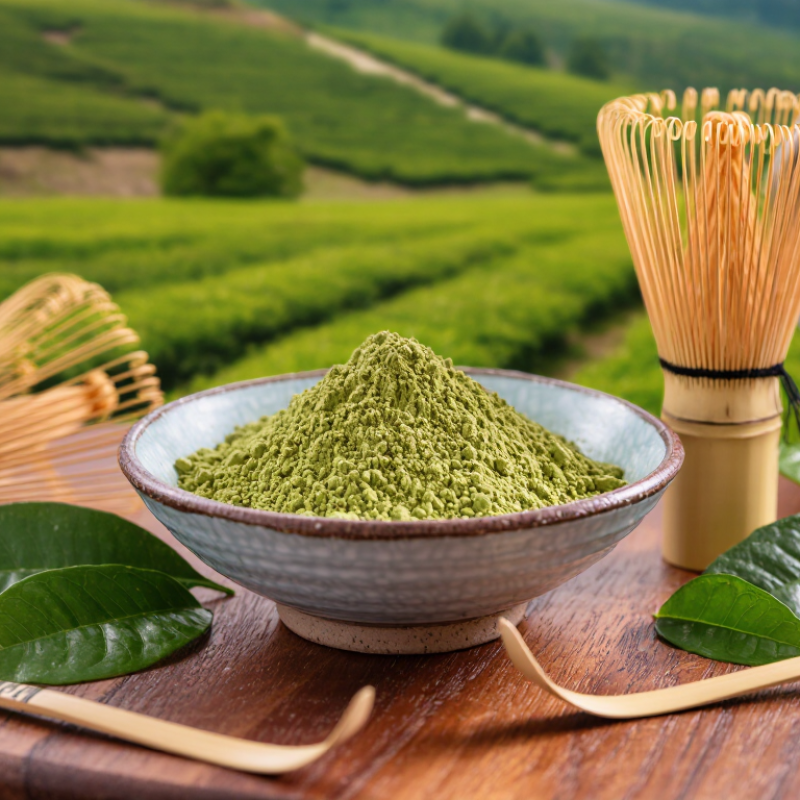
China’s ceremonial matcha supply begins with tencha, not ordinary green tea leaves. Growers shade tea plants for roughly 20–30 days before harvest. This reduces direct sunlight and encourages higher chlorophyll and L-theanine levels. The leaves develop a deeper green color and a softer, less bitter taste. Details matter.
After picking, the leaves are steamed to limit oxidation. Stems and veins are removed during tencha processing. This creates a clean, flexible leaf suitable for milling. Careful suppliers should document harvest timing, shading duration, processing conditions, and laboratory test results. Buyers need those records, especially when purchasing for international markets.
Traditional stone milling turns dried tencha into an exceptionally fine powder. The process is slow and produces limited quantities per mill. Excessive heat can dull the aroma, so controlled milling conditions are important. In a cup, well-made ceremonial matcha may show a vivid green tone, creamy texture, gentle umami, and a fresh finish. Not always. Farm conditions, cultivar, storage, and grinding speed can change the result. My own quality checks would include sieve texture, aroma after opening, color under natural light, and taste in water around 70–80°C. “Ceremonial” is not a universal legal grade. It should describe verified quality, not replace evidence. Global buyers should request traceability, moisture control, contaminant testing, packaging details, and consistent batch samples before approving a supplier.
China’s matcha industry is expanding within a much larger tea economy. The China Tea Marketing Association reported national tea output of about 3.55 million tonnes in 2023. Green tea represented the largest category, supplying much of the leaf used for powder production. Matcha remains a smaller segment, but commercial research estimates place Chinese matcha output near 40,000–50,000 tonnes in 2023. The range is imperfect because China does not publish a separate official matcha production code.
Export figures require similar care. China Customs data recorded roughly 367,000 tonnes of total tea exports in 2023, according to China Tea Marketing Association summaries. Matcha is usually grouped with powdered green tea under broader customs classifications. Therefore, published matcha export numbers are estimates, not exact government totals. Industry reports from ITC Trade Map and commercial market researchers indicate steady overseas demand, especially from food manufacturers, beverage companies, and specialty retailers.
For global buyers, production details matter more than impressive volume claims. Ceremonial-grade suppliers should provide harvest dates, grinding method, particle-size information, pesticide testing, and batch traceability. Bright green powder and a clean, grassy aroma are useful checks, but they do not prove quality alone. I have found that supplier questionnaires often reveal more than polished catalogs. Some data still feels incomplete. China’s matcha sector is growing, yet its statistics need clearer definitions before buyers can compare suppliers fairly.
| Indicator | Latest Reported Figure | Year / Period | Scope and Interpretation | Public Data Source |
|---|---|---|---|---|
| China’s total tea production | Approximately 3.55 million metric tonnes | 2023 | Includes all tea categories, including green, black, oolong, dark, white, and yellow tea. Matcha is only a small processed segment of green tea. | China Tea Marketing Association and national agricultural statistics |
| China’s total tea export volume | Approximately 367,000 metric tonnes | 2023 | Covers all exported tea products, not matcha alone. | General Administration of Customs of the People’s Republic of China |
| China’s total tea export value | Approximately US$1.73 billion | 2023 | The value includes bulk tea, consumer-packed tea, extracts, and other tea products reported under customs classifications. | General Administration of Customs of the People’s Republic of China |
| Official matcha production statistics | Not separately published at national level | Current public statistical framework | Chinese agricultural and customs statistics generally group matcha with green tea rather than reporting a dedicated national matcha line. | National Bureau of Statistics of China; China Customs tariff classifications |
| Official matcha export statistics | Not separately identifiable from standard customs data | Current public statistical framework | Matcha is commonly included within HS 090210 or HS 090220, which also cover other green teas. Customs data therefore cannot reliably isolate ceremonial matcha exports. | World Customs Organization HS nomenclature; China Customs |
| Main Chinese matcha-producing regions | Eastern, central, and southwestern tea-producing provinces | Ongoing | Commercial matcha processing is associated with tea-growing areas in Zhejiang, Guizhou, Hubei, Shaanxi, and surrounding regions. Public statistics do not provide a unified provincial matcha-output total. | Provincial agricultural statistics and tea-industry publications |
| China’s position in global tea production | Roughly one-half of global tea production by volume | 2022–2023 estimates | China is the world’s largest tea-producing country. This is a total-tea indicator and should not be interpreted as China’s share of the global matcha market. | FAOSTAT crop and livestock products database |
| Matcha market growth reporting | No single official national CAGR available | 2020–2024 | Private market reports use different definitions of matcha, ceremonial matcha, powdered green tea, and industrial-grade powder; their growth rates are not directly comparable. | Industry research reports; definitions should be checked before procurement decisions |
| Buyer-relevant export documentation | Commercial invoice, packing list, certificate of origin, food-safety documents, and any destination-specific certificates | Shipment-specific | Import requirements vary by destination. Buyers should verify pesticide-residue limits, microbiological requirements, labeling rules, and customs classification before shipment. | Destination-country food and customs authorities |
Data note: China’s public statistical system does not currently provide a fully separate national series for ceremonial matcha. Total tea production and export figures are therefore presented as industry-wide reference indicators, while matcha-specific entries are identified as unavailable or non-comparable where appropriate.
China’s ceremonial matcha supply is shaped by distinct growing regions. Zhejiang suppliers often work with established tea-making skills and efficient export systems. Their matcha may show a clean green color, soft umami, and balanced bitterness. Buyers should inspect shade-growing records, harvest dates, and milling temperature. These details affect aroma and texture.
Guizhou suppliers benefit from highland terrain, frequent rainfall, and cooler conditions. These factors can support tender leaves with fresh, rounded flavors. Some producers offer smaller batches and stronger farm-level traceability. However, quality can vary between harvests. A reliable supplier should provide laboratory reports for pesticide residues, heavy metals, moisture, and microbiological safety. Samples matter more than attractive descriptions.
Hubei suppliers, especially those near established tea-producing areas, may provide practical capacity and stable processing schedules. Their profiles can suit buyers seeking consistent color, fine particle size, and contract flexibility. Yet “ceremonial” is not a regulated quality guarantee everywhere. Buyers should confirm leaf standards, shade duration, stone-milling or alternative milling methods, and packaging protection from light and oxygen. I would also request a recent sample before a large order. A bright cup can still hide harshness. Supplier evaluation needs repeated tasting, not one impressive sample.
China’s leading ceremonial matcha suppliers should withstand careful buyer due diligence. A lot-specific Certificate of Analysis (COA) is essential. It should identify the batch, production date, laboratory, and test methods. Review pesticide residues, heavy metals, microbiological limits, moisture, and colour-related findings. Generic certificates deserve caution.
ISO 22000 shows a structured food safety management system. HACCP records reveal how suppliers identify and control risks during farming, processing, and packing. However, certification alone does not guarantee consistent quality. Ask whether the certificate remains valid and covers the actual production site. For EU buyers, verify pesticide results against current EU Maximum Residue Levels (MRLs). Testing should use competent laboratories with suitable accreditation. Traceability matters. The supplier should connect finished powder to fields, harvest records, and packing dates.
Tips: Request recent COAs from several production lots. Compare laboratory names, sampling dates, and tested substances. Ask for corrective-action records when results exceed internal limits. Check sealed sample packaging, fine texture, vivid green colour, and a clean umami aroma during evaluation. A professional supplier should answer clearly, though no system is flawless. Leave room for independent testing before a large order.
MOQ and lead time reveal more than a supplier’s catalogue.
Stocked ceremonial-grade lots may start around 5–25 kg, while custom milling or packaging often requires 50–300 kg. These are working benchmarks, not fixed rules. Ask whether the MOQ applies per flavor, harvest, package size, or total order.
A realistic lead time is usually 10–20 business days for stocked material and 30–60 days for custom production. Request a production calendar, not only a sales promise.
Particle size needs technical evidence.
“Ultra-fine” is not a measurable specification. Ask for D10, D50, and D90 results, the laser-diffraction method, and a recent batch report. ISO 13320 supports laser diffraction testing, while ISO 11287 helps classify green tea, but neither defines one universal matcha particle-size target.
Many buyers prefer a D50 near 10–20 microns for a smooth suspension. Still, smaller particles do not automatically mean better flavor. Taste testing matters.
Shelf life should connect with packaging and storage data.
Sealed, oxygen-controlled matcha commonly receives a 12–24-month best-before period, but suppliers should provide stability evidence for the exact package. USDA Foreign Agricultural Service tea reports track China’s tea sector at more than three million metric tons annually, yet they do not verify matcha quality or supplier reliability.
That gap matters. Compare certificates, harvest dates, microbiological results, and retained samples. A neat spreadsheet can still mislead.
I would also record color and aroma after opening, because real buyer experience is sometimes less tidy than the report.
