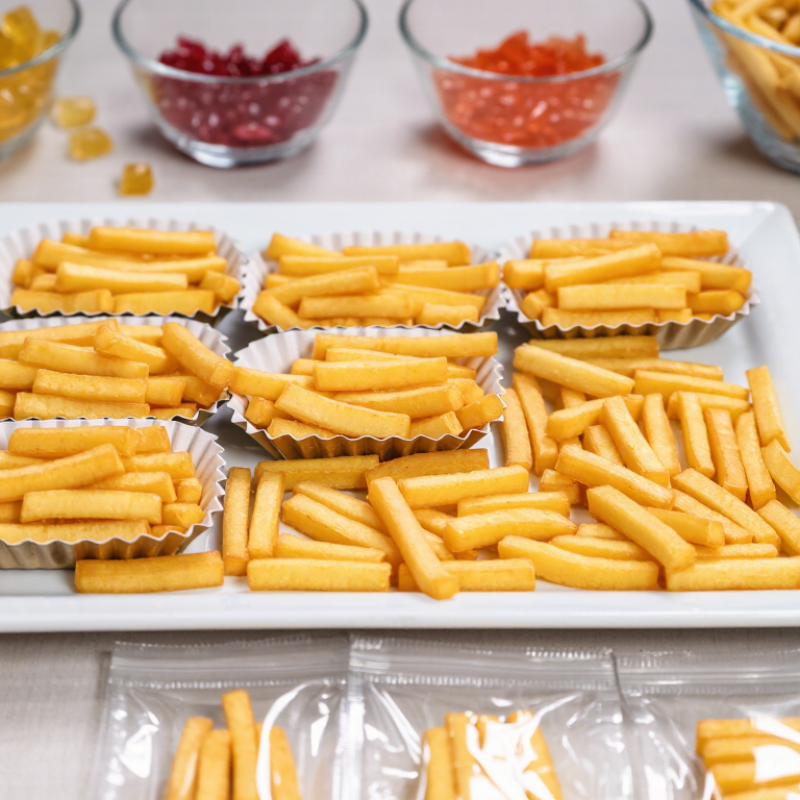
Sourcing French Fries Modeling Gummy Candy in 2026 requires more than finding a colorful product photo. Buyers must examine shape accuracy, flavor quality, ingredient transparency, production capacity, and delivery reliability. A convincing sample should resemble golden fries, with crisp-looking edges, soft gummy texture, and consistent coloring across every batch.
Claire Moreau, a confectionery sourcing consultant with experience in private-label sweets, offers a useful warning: “A realistic shape is valuable, but dependable production keeps the customer coming back.” Her observation reflects a common purchasing mistake. Attractive samples can hide unstable textures, unclear ingredients, or weak packaging performance.
Look closely.
A practical sourcing process should compare manufacturers by mold capability, minimum order quantity, customization options, food-safety documentation, and export experience. Ask for pilot samples before approving large-volume production. Test the candy after storage, not only when it arrives. Heat can soften the gummy fries, while poor sealing may affect flavor and appearance.
Reliable suppliers should explain their gelatin or pectin choices, color sources, shelf-life testing, and carton protection. They should also provide clear production timelines for 2026 campaigns. Certifications matter, but they do not replace direct communication or sample inspection. A certificate can confirm a system, not every shipment.
Buyers should record sample results with photographs, texture notes, and packaging observations. The process is not perfect. Supplier claims may require careful verification. Still, a disciplined comparison can reduce surprises and support a safer, more consistent French Fries Modeling Gummy Candy launch.
French fries modeling gummy candy is a soft confection molded to resemble individual fried potato sticks. It is usually made with gelatin or pectin, sugar, syrup, flavoring, and food-grade coloring. Its appeal comes from visual contrast: a savory-looking shape with a sweet, chewy center. Some versions use a light sugar coating for a dry, crisp-looking surface. Others add fruit flavors, sour notes, or a soft filling. The word “modeling” describes the forming process, not a toy material. That distinction matters for shoppers and retailers.
This candy serves several market uses. It can fill pick-and-mix displays, novelty gift boxes, seasonal collections, and party snack tables. Cafés and dessert counters may use it as a topping for milkshakes, cakes, or ice cream. Event planners can place small portions in clear cups, creating an easy conversation point. Online sellers often show close photographs because size and texture are difficult to judge on screens.
Sourcing teams should request ingredient lists, allergen statements, texture samples, shelf-life data, and packaging specifications. Test heat resistance before ordering. A gummy may soften during transport. Check color stability, too. The category remains inconsistent, and fry shapes can vary widely between factories. That weakness deserves attention. Reliable suppliers should explain mold dimensions, batch controls, and food-safety documentation clearly.
How to Source French Fries Modeling Gummy Candy in 2026?
A reliable specification should begin with the shape. Define each gummy as 70–85 millimeters long, with a narrow body and slightly rounded ends. The surface should resemble a fried potato, not a smooth plastic stick. Use a pale golden color with darker toasted marks, but avoid artificial-looking gradients. According to Innova Market Insights’ 2024 consumer research, six in ten consumers enjoy exploring new flavors. Therefore, consider classic potato, salted caramel, or tomato-seasoned profiles. The flavor must remain sweet, not savory enough to confuse the product category.
Texture needs measurable targets. Request a soft, elastic bite with 8–12 seconds of chew time at room temperature. A thin sugar coating can add a dry, crisp first touch. However, excessive coating may crack during transport. Our early prototype was too sticky. It looked attractive but failed after warm handling. That mistake matters. Ask suppliers for texture testing at 20°C, 30°C, and 35°C, plus shelf-life samples.
Packaging should protect the shape and communicate the playful format. A rigid inner tray can prevent bending, while a moisture-barrier pouch helps preserve chewiness. Use transparent windows carefully; light may fade the yellow color. UNEP’s 2023 Turning off the Tap report states that packaging accounts for about 36% of global plastic production. Request lightweight, recyclable structures and clear material specifications. Confirm net weight, allergen statements, batch coding, and seal strength before approving a production sample. Small details often expose weak sourcing decisions.
This 10-point sourcing score translates key product requirements into measurable development targets: accurate French-fry geometry, recognizable fruit flavor, a soft-chewy bite, and packaging that protects the pieces from heat, moisture, and deformation. A practical starting specification is approximately 45–65 mm piece length, 8–12 mm width, 4–6 mm thickness, medium-to-high flavor intensity, and individually sealed or moisture-resistant packaging.
When sourcing French fries modeling gummy candy in 2026, begin with manufacturer qualification, not attractive samples. Grand View Research reported that the global gummy market reached approximately USD 21.6 billion in 2023. Its forecast also indicated strong double-digit growth through 2030. This growth attracts inexperienced factories. Be careful.
Request the factory’s food-safety certificates, audit reports, allergen controls, and recent laboratory results. ISO 22000 or an equivalent certified system is useful, but certificates alone prove little. Check the issuing body and expiration date. Ask for traceability records covering gelatin or pectin, colors, flavors, and packaging film. A qualified producer should explain every batch code clearly. The factory should also control moisture, texture, and color migration. French fries shapes need clean ridges, even coating, and stable appearance after transport. Test samples after heat exposure, not only on delivery day.
Review production evidence before signing a contract. Ask for line videos, metal-detector checks, mold-change procedures, and three consecutive pilot batches. Compare weight tolerance, piece count, firmness, and flavor consistency. The Food and Agriculture Organization emphasizes documented food-safety controls and traceability as key risk-management tools across food supply chains. Still, one weakness remains: many buyers overvalue a polished sample. I have seen attractive prototypes fail during compression testing. Require independent testing for microbiology, heavy metals, and declared allergens. Evaluate communication speed, corrective-action records, minimum order quantity, and realistic lead times. A factory that admits limitations may be safer than one promising everything.
| Evaluation Dimension | 2026 Sourcing Benchmark | Required Evidence from the Manufacturer | Main Commercial or Quality Risk | Suggested Weight | Evaluation Result | |
|---|---|---|---|---|---|---|
| Product Definition and French-Fry Shape Capability | ||||||
| Product format | Target Individual soft gummy pieces shaped like French fries, with a consistent elongated profile and optional two-color appearance. | Approved product drawing, 3D sample, mold layout, and pre-production sample photographs. | Shape may be recognized as generic candy rather than a French fry; visual inconsistency can reduce retail appeal. | 8% | Pass if sample matches drawing | |
| Dimensional tolerance | Target Buyer-defined nominal size, such as 60–90 mm length and 8–14 mm width, with a documented tolerance of approximately ±5% after production approval. | Dimension inspection record from at least three production lots and calibrated measuring equipment records. | Dimensional variation can affect packaging fill, portion count, and visual uniformity. | 7% | Verify by lot sampling | |
| Texture profile | Target Soft, elastic, non-sticky texture with a controlled chew; target firmness and water activity must be agreed during product development. | Texture specification, water activity results, retained samples, and accelerated shelf-life data. | Excessive stickiness, hardening, or moisture migration may cause consumer complaints and packaging problems. | 8% | Approve after sensory and lab review | |
| Color and appearance | Target Stable fry-like color combination with no bleeding, frosting, surface cracking, or visible air pockets. | Color standard, approved golden-sample panel, color measurement method, and defect limits. | Color migration or surface defects may be amplified by transparent packaging and retail lighting. | 6% | Pass after golden-sample approval | |
| Formula, Dietary Requirements, and Label Readiness | ||||||
| Gel system | Select Gelatin, pectin, starch, or blended systems may be used; the selected system must meet the target texture, dietary claim, and market requirements. | Full ingredient specification, allergen statement, processing description, and declaration of animal-derived ingredients. | Formula changes can affect texture, labeling, consumer acceptance, and import documentation. | 7% | Score after formula review | |
| Allergen and dietary control | Required Written assessment for allergens, gelatin source, gluten status, artificial colors, and any vegetarian or vegan claim. | Allergen matrix, supplier declarations, cross-contact control plan, and claim substantiation documents. | Unsupported dietary claims or undeclared cross-contact can create regulatory and recall exposure. | 8% | Pass only with documented controls | |
| Label compliance | Required Ingredient and allergen labeling must be adapted to the destination market. For the European Union, food information requirements are governed by Regulation (EU) No 1169/2011. | Destination-market label draft, nutrition calculation, ingredient list, allergen declaration, and packaging artwork approval workflow. | Incorrect labeling can delay customs clearance or require relabeling and product withdrawal. | 8% | Pass after regulatory review | |
| Color and additive compliance | Required Colors, sweeteners, acids, glazing agents, and preservatives must be permitted for the intended destination market and used within applicable limits. | Technical data sheets, certificates of analysis, formulation percentage ranges, and destination-market regulatory review. | Permitted additives and warning statements differ by jurisdiction. | 7% | Verify by destination market | |
| Food Safety, Certification, and Manufacturing Controls | ||||||
| Food safety system | Required Documented HACCP-based food safety controls with traceability, sanitation, pest control, foreign-material prevention, and corrective-action procedures. | Current third-party food safety certificate, audit report or summary, HACCP plan, recall procedure, and traceability test results. | Weak preventive controls increase microbiological, foreign-material, and recall risk. | 12% | Minimum qualification gate | |
| Microbiological testing | Required Lot-based testing plan appropriate for a low-moisture or intermediate-moisture confectionery product, including yeast and mold and relevant pathogen controls. | Recent laboratory reports, sampling plan, laboratory accreditation details, and out-of-specification procedure. | Inadequate testing can allow contamination or shelf-life failures to go undetected. | 8% | Pass with recent records | |
| Foreign-material control | Required Effective sieve, magnet, metal-detection, visual inspection, and glass or brittle-plastic control procedures where applicable. | Critical-control-point records, detector verification logs, calibration records, and incident history. | Foreign-material incidents can lead to customer complaints, rejected shipments, or recalls. | 6% | Pass with verified records | |
| Batch traceability | Required Raw materials, packaging materials, production dates, and finished-goods lots should be traceable through a documented coding system. | Mock recall result, lot-code sample, raw-material traceability record, and retention-sample procedure. | Poor traceability increases the scope and cost of a corrective action. | 5% | Pass if mock recall is effective | |
| Capacity, Commercial Terms, and Supply Reliability | ||||||
| Minimum order quantity | Benchmark Custom molded confectionery projects commonly require a trial order, dedicated mold investment, and a larger repeat-order quantity; exact MOQ must be quoted by format and packaging. | Written quotation showing trial quantity, production MOQ, mold charge, packaging MOQ, and price breaks. | Unexpected minimums can create excess inventory and increase launch cash requirements. | 6% | Compare total landed cost | |
| Tooling and mold ownership | Required The agreement should define mold ownership, storage, maintenance, replacement, exclusivity, and use restrictions. | Tooling quotation, mold drawing, ownership clause, maintenance terms, and exit provisions. | Unclear ownership may restrict future sourcing or cause transfer delays. | 5% | Pass after contract review | |
| Production capacity | Target Capacity should cover forecasted demand plus reasonable peak-season volume without compromising inspection or lead time. | Monthly capacity statement, current utilization range, line capability, maintenance schedule, and capacity reservation policy. | Overloaded lines may cause delayed shipments, rushed approvals, or inconsistent quality. | 6% | Validate against forecast | |
| Lead time and sample process | Benchmark Require documented stages for concept sample, mold sample, pilot run, artwork approval, first production, and repeat production. | Project schedule with approval gates, estimated lead times, change-control process, and delay escalation contact. | Uncontrolled revisions can extend launch timing and increase development cost. | 5% | Compare project schedules | |
| Export and logistics readiness | Required Capability to provide commercial invoice, packing list, certificate of origin where applicable, product specifications, and shipping-compliant documentation. | Sample export document set, Incoterm quotation, carton dimensions, pallet configuration, and shelf-life statement. | Documentation errors can cause customs delays, storage fees, or shipment rejection. | 5% | Pass if document set is complete | |
| Recommended Qualification Decision | ||||||
| Scoring method | Score each dimension from 1 to 5, multiply by the suggested weight, and calculate a weighted total. A manufacturer should normally meet all required food-safety and regulatory gates before commercial scoring. | 100% | Recommended threshold: 80/100 | |||
| Final shortlist rule | Shortlist manufacturers that pass the mandatory gates, provide representative production samples, demonstrate documented traceability, accept the agreed product specification, and offer commercially viable tooling, MOQ, lead time, and landed-cost terms. | Gate | Qualified for RFQ or pilot order | |||
Demand is expanding. Grand View Research valued the global gummy market at about USD 19.1 billion in 2023. It also forecasts a 12.5% CAGR through 2030. French-fries-shaped gummies need more than attractive photos. Request identical samples from at least three factories. Compare potato-bag details, fry length, color consistency, softness, and flavor release. Cut each sample after seven days. Texture can change noticeably.
Pricing should separate candy, custom molding, packaging, testing, tooling, and freight. A low unit price may hide expensive molds or high minimum order quantities. Many suppliers quote between 500 and 5,000 kilograms for customized candy, but this varies by formula and equipment.
Ask for tiered prices at 500, 1,000, and 3,000 kilograms. Include a written replacement policy for damaged packaging. I once overlooked carton volume. That mistake increased shipping costs.
For certification review, request current HACCP or ISO 22000 documentation, allergen declarations, ingredient specifications, and certificates of analysis.
BRCGS certification can strengthen supplier screening, but it does not replace batch testing. Check microbiological results, heavy metals, color additives, shelf life, and traceability records.
The Food Safety Modernization framework emphasizes preventive controls and documented supplier verification. Do not accept an undated certificate. Also confirm whether testing covers the exact gummy recipe. A sample may pass, while the production batch differs. That uncomfortable gap deserves attention.
How to Source French Fries Modeling Gummy Candy in 2026?
Supplier terms should be agreed before approving the final sample. Define piece weight, length, color, flavor, texture, and monthly capacity in writing. A practical specification may include 8–10 grams per piece and a soft, elastic bite. Confirm the acceptable color range with physical references, not only digital images. Request production samples from the same line planned for mass manufacturing. Ask about ingredient declarations, allergen controls, batch coding, and traceability records. Clear documents reduce expensive surprises.
Quality checks should cover appearance, weight variation, moisture, texture, packaging seals, and carton strength. We would inspect samples from different production points, because one perfect tray proves little. Keep retained samples from every approved batch. A small weakness remains: texture can change after long storage or temperature movement. Therefore, conduct stability checks under realistic transport conditions. Review test results with an independent food safety professional when technical data seems incomplete.
For 2026 delivery, build a schedule backward from the selling date. Include time for sampling, artwork approval, production, inspection, customs clearance, and inland transport. Set a firm shipment window, plus a reasonable buffer for port congestion. Split large orders into planned releases if storage space is limited. Agree on payment milestones after measurable approvals, not vague promises. Review forecasts every month. Our early forecasts were too optimistic once. A written corrective process is essential when demand, texture, or packaging requirements change.