
China Top Powdered Beets Benefits for Global Buyers
For global buyers, China is an important place to explore beetroot powder suppliers, product formats, and export options. Powdered Beets Benefits can include convenient storage, easy blending, and a vivid red-purple color in drink mixes, bakery products, and other formulations. The powder is made from beetroot that has been dried and milled. Its taste, color, and nutrient profile can vary with the beet variety and processing method. Details matter.
A buyer comparing suppliers should look beyond a bright sample or an attractive price. Ask for the ingredient specification, country-of-origin details, processing information, and a recent certificate of analysis. Check how the supplier tests for microbiological quality and contaminants, and confirm that documentation matches the intended market’s requirements. These checks support informed sourcing; they do not guarantee every batch will perform identically. Small differences in moisture or particle size may affect flow, color, and mixing.
Beetroot powder is not a medicine, and its potential uses should not be presented as proven health outcomes. Product claims need careful review. For procurement teams, the practical value may be simpler: a plant-based ingredient that can add color and beet character without handling fresh roots. Request a representative sample and test it in the actual recipe. A cup of water is not enough. Supplier transparency is useful, though buyers should still verify the evidence themselves.
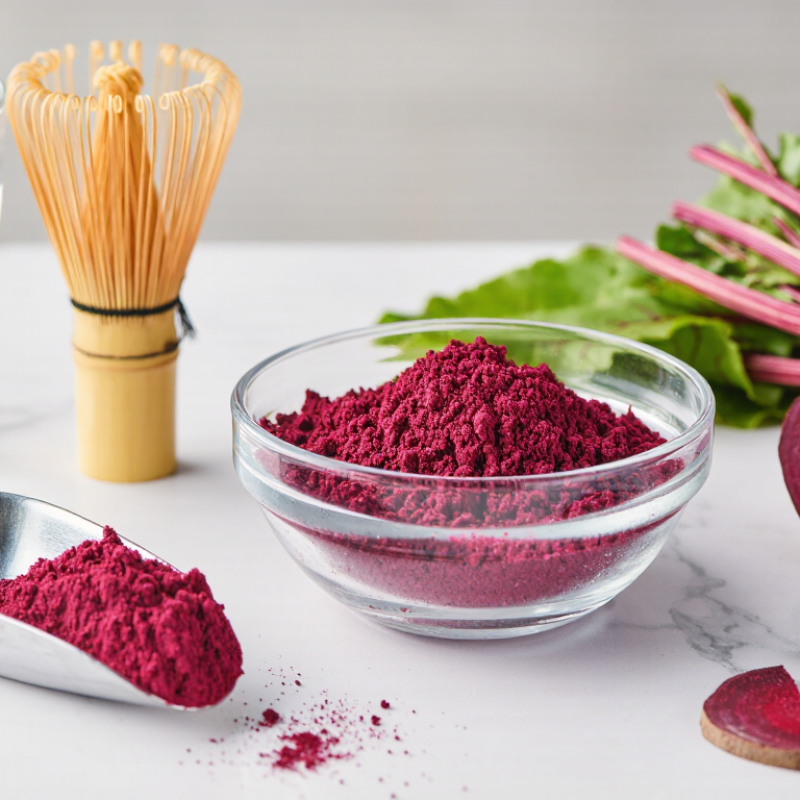
What Powdered Beets Are and How They Are Produced in China
China’s powdered beets are made from beet roots that are washed, trimmed, and cut into smaller pieces. The pieces are dried to reduce moisture, then milled and screened into a fine powder. Drying conditions matter: too much heat can dull the red-purple color, while uneven drying may affect texture and storage stability. There is no single perfect route. Equipment, raw material, and target specifications all influence the result.
For global buyers, production details are more useful than a color sample alone. Ask whether the powder contains only beetroot, and request specifications for particle size, moisture, and color. Independent test reports can help assess microbiological quality and contaminants. Check how the powder is packed, too; sealed, moisture-resistant packaging helps protect it during transport. Samples should be compared in the intended use, such as a drink mix or baked product, because color and flavor can change after processing. That part is easy to overlook. A vivid sample does not guarantee every shipment will match, so clear acceptance criteria and batch records matter.
China Top Powdered Beets Benefits for Global Buyers - What Powdered Beets Are and How They Are Produced in China
| Category | Dimension | Information for Global Buyers |
|---|---|---|
| Product Overview | What powdered beets are | Powdered beets, also called beetroot powder, are made from beet roots that have been cleaned, cut, dehydrated, and milled. The product is generally used as a food ingredient rather than as a fresh vegetable. |
| Product Overview | Appearance and flavor | It is typically a red to deep-purple powder with an earthy, mildly sweet beet flavor. Color and flavor can vary with beet variety, growing conditions, drying method, and storage. |
| Production in China | Raw-material preparation | Beet roots are sorted to remove damaged material, washed to remove soil, and trimmed. They are commonly sliced or diced to support more even drying. |
| Production in China | Dehydration | Prepared roots are dried using a suitable food-dehydration process. Drying conditions affect the finished powder’s color, flavor, moisture, and handling properties. |
| Production in China | Milling and screening | The dried beet material is milled and may be screened to achieve a more uniform particle size. Powder is then packed in food-grade packaging designed to limit exposure to moisture, air, and light. |
| Potential Benefits | Vegetable-based ingredient | Beet powder offers a convenient way to add beet-derived color, flavor, and solids to recipes without handling fresh roots. Its nutritional composition depends on the raw material and processing method. |
| Potential Benefits | Natural color contribution | Beets contain betalain pigments, including red-violet betacyanins. These pigments can contribute color to foods, although their stability is affected by factors such as heat, light, oxygen, and pH. |
| Potential Benefits | Convenient storage and use | Compared with fresh beet roots, a dry powder is easier to portion, blend into dry mixes, and transport in compact packaging. It should be kept sealed and stored according to the supplier’s instructions. |
| Food Applications | Common uses | Potential applications include beverage blends, smoothies, bakery products, soups, sauces, seasoning mixes, confectionery, and other foods where beet flavor or color is appropriate. |
| Handling | Mixing and solubility | Beet powder may disperse in liquids, but it is not necessarily fully soluble because it contains plant material and fiber. Mixing performance depends on particle size, formulation, and preparation method. |
| Quality Checks | Documents and specifications | Buyers can request a current product specification, certificate of analysis, ingredient statement, allergen information, microbiological results, and applicable contaminant testing for the intended market. |
| Quality Checks | Parameters to confirm | Confirm the product’s botanical source, processing method, particle-size information, moisture or water-activity specification, color description, packaging, shelf life, and storage conditions directly with the supplier. |
| Import Planning | Regulatory and labeling review | Food ingredient requirements vary by destination market. Importers should verify permitted uses, labeling rules, food-safety documentation, and any relevant import controls before placing an order. |
Buyer note: Product characteristics and test results vary by raw material and processing conditions. Confirm the agreed specification and supporting documents for each lot; the information above is general and is not a substitute for a supplier’s product documentation.